You can administrate representatives of your own or any other taxpayer you have a privilege to. There several rules for assigning and revoking the privileges or the right "to operate on behalf of the represented taxpayer":
•If the representative (particular external user representing particular taxpayer) needs to have a privilege "Assign the right to operate on behalf of the represented taxpayer", only the administrator can assign that right to him. This function can be done by assigning representation right.
•You cannot assign the same representation (a representation with a same username of taxpayer representative and the same TIN of the represented taxpayer in the state "Active" or "Requested") twice.
•If representation rights were assigned by administrator, only administrator is able to revoke the rights of that representation.
You are able to assign rights to represent yourself, only if you are a registered taxpayer with TIN assigned to your user account:
1. Open a list of representatives by selecting menu “Taxpayer → Taxpayer representatives”. A list of taxpayer representatives is opened (see Figure 27).
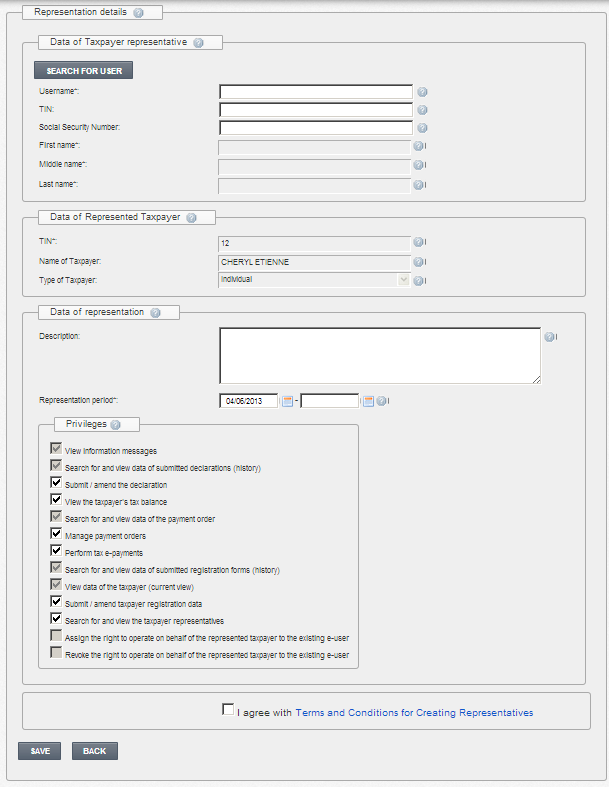
2. Click [New]. A form for new representation’s data is opened (see Figure 29).
3. Enter data of new taxpayer representation.
3.1. Search for representative:
3.1.2. Click [Search for user]. User data is loaded.
3.1.3. To clear loaded data click [Clear user]. And proceed from step 3.1.1.
3.2. Enter description, if any.
3.3. Select representation period.
3.4. Choose representation privileges.
3.5. Tick field {I agree with Terms and Conditions for Creating Representatives}.
4. Submit data by clicking [Save]. Representation state is set to Requested. Now assigned user has to confirm or reject assigned representation rights.
4.1. Only if he/she accepts to be a representative, the representation is set to state Active. The external user can represent you as a taxpayer.
5. If the particular external user refuses to represent you, the state of representation is set to “Rejected”. The external user cannot represent you as a taxpayer.
Figure 29 New representation form